Saturday, March 3, 2012

India, part 2


From another letter Jenny sent her family:

Temples on the way from Chennai to Pondicherry, carved out of living stone
India (part 2)

I begin this letter while riding on a train north from Delhi to Kalka.  We are headed to a friend's mother's cottage in the tiny former British garrison town of Kasauli in the foothills of the Himalayas.  Our friend, Mohit  Bhargava, is a native Indian we met in Slovenia in October.  He and his wife Rebecca, an American from Wisconsin, were on their honeymoon.   They both live in Melbourne, Australia and we plan on seeing them when we get to Oz.  Mo encouraged us to look up his mother, Lily, while in India to experience a home-stay.  So now we head to colder weather and, hopefully, a quiet week in the mountains.

On the way to Pondicherry
The weeks since I last wrote have been astounding, overwhelming, fantastic - and exhausting.  India has drawn on our reserves both physically and mentally.   None of our prior experience traveling or just being alive prepared us for the challenges of India.  It is hard to see an entire country in such an incredible state of chaos, decay and poverty.  Yet, as a good friend of Bob Burleigh said, India is on its way up.  In the past 10-20 years modernization has been taking hold as evidenced by massive road and transportation projects, housing developments, universities, environmental protection initiatives, women's rights campaigns and leadership in the medical and computer technology fields.  All this is being done around an astounding population of 1.2 billion that equals 390 people per square km.  (The US has 30 people per square km).  Most of the populated areas are packed with people living in appalling conditions while skyscrapers and overhead metro lines are being built.  Most people have no running water and limited electricity.

Does lobster from the Bay of Bengal taste as good as Maine's?
I have asked myself repeatedly how an entire country can develop in the face of such enormous, seemingly insurmountable needs and obstacles. Yet India seems to be doing it.  There is a reported 85% literacy rate in the country with some states coming in at 100%.  Education is mandatory until 5th grade and attendance is enforced. 


I am not sure about whether the homeless children are receiving education.  There are many, their matted hair and filthy clothes contrasting markedly with the immaculately groomed and dressed schoolchildren making their way to and from school every day. 
   
At the Gandhi memorial, Pondicherry
In Agra, despite the astounding air pollution, we saw hope in dumpsters that were actually being used and a noticeable reduction in trash on the ground.  Parts of Delhi and Chennai actually looked walkable and like a modern city.   One of Bob Burleigh's Indian friends, AJ, has started a financing company that funds a group called World Haus. (see worldhaus.com). World Haus' vision is to provide adequate housing to the poor around the world.  India is a major focus, with 500 million people needing either basic shelter or better housing.  The homes start at 220sq feet and are made of brick.  They are powered by PV. Each has an outhouse with a sealed containment system.  Sounds terribly basic, but one has to start somewhere.

I cannot discuss the state of India without discussing the spirit of the people.  Despite the enormous disparity between those who have and those who don't have, the spirit of the people seems to be very intact.  Sure, there is desperation on some people's faces, but most are energetic and smiling.  Most are very busy living their lives and making the best of it.  Every place we go looks and feels chaotic but we rarely hear a harsh word spoken.  They honk their horns merrily or simply nod and move on.  Among the chaos is a benign politeness that I have never experienced in the West.  It can be unsettling to an American who is used to personal space and the concept of a line and "I was here first".  In India, if there is space in a line, it is quickly filled.  But it is done in such a benign way that you just roll with it.   We have been taking many deep breaths and saying "Om" a lot!  One would think that with this mass of humanity and so many people living very marginal lives that tempers would flare and violence would break out.  We have seen and sensed none of this.


The last letter left off with us departing the train in Chennai.  Chennai used to be called Madras when the Brits were here.  It sits on the eastern coast of southern India and boasts the 2nd longest continuous urban beach in the world.  It is also one of the most prosperous cities in India and there is some intermittent evidence of the new economy as one travels around the city.  Our driver met us at the train station, which is the busiest in India.  Since over 30 million people travel by train in India every day, having the distinction of being the busiest station is a very big deal.  We wound our way through the masses to our car, jumped in and sped off to the Marriott Courtyard hotel to meet Bob Burleigh who was in Chennai on business.  There is no such thing as fast driving in India; just insane driving.  We’ve heard that Chennai roads have improved greatly since the cows were removed from the streets.

The Marriott was like Shangri La.  All sparkly and new.  Bob was there to meet us and it was great to see him.  Since it was early we rested up for a bit and then met Bob and his business associate VJ, brother of the above-mentioned AJ, and his wife Radhika for lunch. VJ is the owner of the medical billing company for which Bob consults.  VJ's company also provided us with a travel agent who oversaw our travel plans and itinerary while in India. Bob has basically become a member their family.  He was invited to their wedding in Mumbai eight years ago.  In India weddings are elaborate, with hundreds to thousands of guests, horses, elephants, and much money spent.  Bob said the wedding was incredible. Later, Radhika kindly took us shopping to buy some India wear, pick up some souvenirs and to see some of the sights.

The next four days were filled with activity.  Bob was very excited to show off India and the areas he has become so familiar with.  He has been here about 15 times and has grown to love India.  We headed south the next day about 200km to Pondicherry.   It is an old French colonial town with some cool architecture and an expansive seaside area with an impressive old sea wall.  In the 2004 tsunami that devastated Thailand, the sea wall saved Pondicherry from massive damage.  Along our drive down and during our stay we toured a number of very exotic Hindu temples.  I don't really have a frame of reference for Hindu temples but I thought they were fascinating.  Some ancient ones seemed serene without their paint but those still in use were painted in wild colors, depicting various Hindu stories.  We reminded ourselves that ancient Greek temples and statues were painted similarly.  Hindus pray to thousands of deities.  However, theses gods are really manifestations, or personalities, of their one god Brahman.  One of our cooks on the Kerala houseboat tour said that Hinduism is more a way of life than a religion.

The center of Auroville - and the Universe?

Pondicherry is home to Auroville, the famous ashram.  Auroville was started in the 1960’s by Sri Aurobindo, an Indian, and a French woman adoringly called "The Mother".  You get the idea.  They wanted to create a community that promoted unity among cultures.  Therefore, they bought a large chunk of land and invited everyone who wanted to live peacefully and work on building the community.  Today, even though Aurobindo and "The Mother" have long since passed, Auroville is going strong with an average of 2000 people at any given time living and working on the farm/town.   Many people come to live for months or years at a time.  They make and sell all sorts arts and crafts to help support the town and its cause.  

The spiritual center of the property is a huge golden outer space-like orb.  The orb is the place where community members and the public can come and "concentrate" (not meditate, as the community does not espouse any religious ideology), to bring about consciousness of unity.  We went into the very groovy orb, climbed ramps into the center and "concentrated" for about 45 minutes in the presence of a huge crystal ball illuminated by a beam of sunlight coming from the top of the orb.  It was very refreshing.  Additionally, it was very clean and quiet, a welcome relief from the chaos of India.  The community doesn’t qualify as a cult because people come for short periods of time to live then move back to their prior homes, hopefully with more unity in their hearts to spread throughout the world.  Auroville was a tad "woo woo" but kind of cool, too.

Temple elephant about to punch Doug for skimping on the donation
We finished our visit to Pondicherry with Doug and Kate getting blessed by a temple elephant. The elephant will tap your head to bless you but only after you put a coin in its trunk. Smart elephant.  At first Doug tried it without a coin and the elephant refused the blessing.  We got a good laugh.  I stood back and took photos.

The collector
Chennai fishing boats


We returned to Chennai two days later.  There we had one our favorite days in India.  Another of Bob's business associates, Shaji, enlisted one of his friends to take us on a tour of the city.  We woke early to get to the fish market by sunrise.  We wound through the waking streets until we came to the shore where we saw a mass of colorful fishing boats crowded into a tiny harbor, off-loading their catch.  We gingerly stepped out of the car into the mud and god knows what else and walked along the docks taking in the smells, sounds and sights of this daily aspect of life in India.  Fishermen and women selling fish were jammed into every conceivable space.  We just stood and watched.  Needless to say, we were watched right back.
Chennai Hindu temple
We walked along some street bazaars and visited one of the oldest Hindu temples in Chennai.  The temple was a-buzz with activity.  People gave offerings to the god, children ran around and we even saw the end of a wedding ceremony.  Seeing the children reminded me of after church when all the adults are standing around yakking and the kids are running around chasing each other.  As we walked around many people came up to us smiling and bowed with their hands together in the welcoming gesture of "Namaste”.  It made us very happy.

We spent the rest of the morning walking down a typical street loaded with vendors selling their wares.  This is where Kate and I got henna tattoos on our hands and Kate got a sari.  Shaji and his friend Melia were absolutely amazing to us.  They whisked Kate into the sari shop, picked out a sari and wrapped the seven meters of gorgeous silk cloth around her and then bought it for her.  We were stunned.  Granted, seven meters of silk cloth was $15 but we couldn't believe it.  They also paid for the henna tattoos.  I asked Melia why they were doing all this.  She said that we were her guests in this country.  “This is what we do.”  We ran into this generosity and graciousness time and time again.  Being down on the streets of India and feeling the energy was great.  Even though it was chaotic I felt like I was a part of it instead of an outsider looking in.
Melia, Shaji, Kate, Jenny and Bob in Chennai

Kate's sari
The next day we flew to Goa, a tiny Indian state on the west coast, south of Mumbai.  Bob flew out the night before.  It was hard to say goodbye.  We had a great time with him and it was good to see a familiar face.  Frankly speaking, I wanted to accompany him back to the US and be on my own soil among my own culture.  I am weary of feeling foreign.  Australia will be an improvement.  Only two more months to go before we land there.  Doug and I are counting the days.  Kate, despite missing her friends, wants to go deeper into the jungle.  She loves it.

Goa beach
 For four days we hung out in Goa.  Goa is renowned for its incredibly big beaches and its party atmosphere.  Many Europeans, British and Russians come here to get out of the cold and party.  Goa was quite pretty.  Very lush, noticeably less litter, good air quality and a real beachy feel.  We found a beautiful beach that was relatively empty and walked for a long time enjoying the near-solitude.  The touts still find you but there are less of them.  Along the beach were real grass huts you could rent, funky restaurants serving great Indian food and colorful fishing boats ready to head out for a day’s catch.  Goa is also a big yoga retreat area so we saw some well-trained yogis doing some cool tricks on the beach.  Definitely a hippie zone.

Kate hangin' at a beach bar, Goa
We headed north after our break in Goa to Agra, the home of the Taj Mahal.  We had heard that this could be an intense place with significant crowds and touts.  They were right.  To get there we had to fly to Delhi and then drive south 200km to Agra on what the map showed as a major freeway.
    
WRONG!  The drive was harrowing.  I added many more gray hairs to my head in the 5- 1/2 hrs it took to go 120 miles.  Our flight got in late and as we were leaving Delhi the sun was setting so we did the whole thing in the dark.  Doug described the roadside scenes as "post apocalyptic" and like "descending into the Stygian gloom".   The road was lined with barely illuminated shabby huts with goods to sell, piles of burning trash with people huddled around for some warmth, people squatting in the dirt around steaming pots of food and just hoards of people everywhere spilling out into the lanes.  In the lanes were cars, trucks, scooters carrying 4-6 people at a time, rickshaws designed for three passengers loaded with 12-15 people with arms and legs sticking out of all sides, bicycles carrying three people, carts pulled by oxen, tractors and camels, vehicles with no lights and vehicles driving the wrong way on a four lane highway.  Our driver drove through this madness with grace and a constant hand on the horn.  I finally had to stop looking.  I did have a moment of wondering if we would arrive alive.

Which way to go?

Detail inside the Taj Mahal

Semi-precious stone inlays, Taj Mahal

Jenny and Kate through one of the marble screens, Taj Mahal

Detail, Taj Mahal

Dome of the Taj Mahal from the side

Shah Jahan's porch at the Agra fort

Interior, Shah Jahan's "prison" at the Agra fort

More stone inlay, Agra fort
Our time in Agra was spent seeing historic sites of the Mughal (Mogul) era in India.  The Mughals ruled India from 1526 to the early 1700s.  During that time they built some impressive palaces, mausoleums and forts.  The Taj Mahal is the most famous of their legacies and deservedly so.  We visited the Taj at sunrise on a misty Sunday.  It was spectacular.  The photos you have always seen are accurate but they leave out the beautiful red sandstone mosques standing on either side of the Taj.  Part of what makes visiting the Taj such an experience is being in this beautiful place with gardens, reflecting pools and spectacular architecture, while remembering what you had to go through to get in.  Now there is a story.

We arose early, grabbed a quick cup of Indian tea and braved hiring a rickshaw to take us over to the Taj.  The sky was just starting to lighten when we sped off through the winding streets.  Along the way we got to see an impressive dog fight, homeless rustling in their blankets on the sidewalk and vendors opening up their carts for the day.  Our very nice rickshaw driver dropped us off outside the "no drive" zone and we proceeded on foot the rest of the way.  The monument is protected by an absurd rule that limits internal combustion engines within 100 meters of the walls.  As if the effects of the oatmeal-thick smog are ameliorated one iota by this tiny effort.  But it's a start.
 
We had walked this same street the evening before looking for a "roof-top restaurant" described in the Lonely Planet guide so we could get a view of the Taj at sunset.  We never found the restaurant.  What we did find was a very confused tangle of narrow cobblestone streets lined with open sewers, kids playing cricket in the street, cows crowding the sidewalks and broken-down buildings that couldn't possibly support a rooftop restaurant. We finally gave up as the sun had set and returned to our waiting driver parked outside the mayhem.  This morning however, the street was quieter and lined with monkeys scavenging for food.  They were very cute.


We found the Taj Mahal’s west gate along with other sleepy visitors.  We bought our tickets and headed to the line to get in.  In India, they have separate lines for "gents" and "ladies" especially if there is a security check involved.  Only women guards pat down ladies.  Oddly, foreigners are separated from Indians.  At first I thought they checked the foreigners more thoroughly.  But from what I have seen there is no difference in the security level.  What is different is that gents are whisked through and ladies are heavily checked.  So Kate and I headed off into the foreign ladies line and waited while Doug sailed off to the foreign gents line and got through in no time.  He smiled and waved encouragement from inside, making an obvious show of enjoying himself, while delinquent monkeys jumped up and down on the corrugated metal roof above us, creating a massive racket.  Grrrrrr.
  
Kate and I stood in line for about an hour, even though there were only 30 women ahead of us.  When we went through we had our backpack checked.   The very grumpy gal checking bags pulled out food from the bags of women in front of us and tossed it in a trash can, ignoring the pleas of the owners.  When she got to mine she pulled out Mattie, Kate's beloved stuffed cat that has gone everywhere with us since Kate was three, and said gruffly, "No!"  I gasped, looked at Kate who had a pained expression on her face, and looked back at the woman.  I think my gasp and Kate's face softened her a little.  She said I could put Mattie in a locker, for a fee, outside the gate and retrieve her when we left.  I gave Kate the pack, grabbed Mattie and forced my way against the queue in search of the lockers.  They were about a 1/2 mile from the gate in a dingy building.  So Mattie stayed in the klink and I forced my way through the queue again, made eye contact with the security lady who did a quick pat down and let me through.  WHEW!  There was no way Mattie was going in a trash can at the Taj Mahal. We retrieved Mattie after our tour and she is looking at me as I write this.
The Taj was worth the slog.  It sits above the sacred Yamuna River on a pedestal, its lack of terrestrial background designed to trick the eye as to its actual proportions.  It is very large anyway and its proportions are exactly fitted to the surrounding buildings and walls.  The marble walls are beautifully inlaid with precious and semi-precious stones in floral patterns – Islam forbids the depiction of animals and humans.  Light enters the interior through stunning, intricately carved marble screens.  As in so many other places, we were disappointed by the grime that had been allowed to build on the walls where people pass.  Pretty sad.  Based on the number of people we met in India who were cutting their visits short because of their reaction to the filth, India pays a high price for not maintaining even basic cleanliness.  It’s exasperating. 
Poor Shah Jehan.  He built the Taj as a mausoleum for his favorite wife but spent the remainder of his life looking at it from a mile away in his prison in the fortress he built across the Yamuna River.  His son had deposed him soon after the Taj was finished.
We drove back to Delhi in daylight, thankfully, and spent one night. We then woke early to catch the train to Kalka, and then by car up to Kasauli.   It was on that train that I started this letter.  Now I am back in Delhi after our time in the “hills”.  As I said, we had hoped our time in Kasauli would be restful.  It wasn’t.  We bailed after three days.  The main problem was that the temperature was about 30-40 degrees F. and the Indians don't install heat in their houses.  I didn't even think to ask.  Just as when you rent a car you don’t think to ask whether it includes an engine.  The house/condo we were staying in was lovely and perched on a steep Himalayan hillside with an incredible view.  It had cold marble floors, high, frigid ceilings and lots of windows that let in the night chill.  When we walked in we were very pleased but noted that it was colder indoors than out.  I searched for the thermostat and there was none.  Hmmmm.  There must be some heat source?  The place did have a tiny fireplace that had never been used and a space heater in our bedroom.

Rooftops and the hills, Kasauli
We unpacked and then went up to our friend's mother's house for tea.  Lily, Mo's mother, is a very wonderful woman and welcomed us with open arms.  She lives in Delhi year-round and comes up to her mountain house when she can.  Her house was in the same complex as ours.  She clearly uses it a lot as it was very cozy with rugs and comfy furniture but no heat. She is a tough lady.  She did have a working fireplace and space heaters.

Even Lily admitted it was quite cold for the season.   We spent a lovely evening getting to know her and deciding on our plan for the next day.  We trotted back to our spot with extra blankets and a second space heater, moved Kate into our room on a mattress, put on all of our clothes and huddled in our frosty beds for the night.  I kept thinking, ‘We can do this, we're from Maine!  We aren't wimps!’  Well....we're wimps.  The next day the power went off and that decided it.  What semblance of heat we got from the heaters was now gone.  However, we were stuck up there until we could get a train out so we ended up staying three nights and leaving on February 10th.   Thankfully, the fireplace did work and the employees of the complex scavenged some wood for a fire on the last night.  We huddled around it and stayed relatively warm.

The Lawrence School at Sanawar - a vestige of Empire
During our three days we made the best of it and walked the hilltop town of Kasauli, toured the Lawrence School at Sanawar featured in Rudyard Kipling's book "Kim", checked out some local  Hindu temples and British graveyards and took a walk along the road our house was built on.  From our balcony we could watch locals tending their cows, sheep and goats on the hillsides.  We could hear their calls and the sound of limbs being chopped off trees to provide food for their livestock.

The hills are overgrazed and there is not much feed.  The people that live up here are poor but seem to be doing OK.  There is a noticeable influx of money as wealthy people from Delhi are building second homes to escape the heat of Delhi in the summer.  The disparity of those that have and those that don't was shocking.  The locals live in tarp-roofed shacks in the shadow of big homes and condos that sit vacant 10 months of the year.  The locals work as cooks, house cleaners and caretakers when the owners come up.  We decided to have a cook because buying and preparing food in India is very challenging.  We were attentively waited on the whole time we were there.  I did my best to not cringe as I was really uncomfortably with being served like that.  At the same time, I was very grateful for not having to deal with meals.

Sad memorials to the price of empire at the British cemetery

The British cemetery near Kasauli
Now we are back in Delhi waiting for our flight to Kathmandu on the 15th.  Delhi is a big city with many walkable areas that remind us of Paris and Washington DC.  This city has pleasantly surprised us with its organization, green spaces, sidewalks and effective trash control.  The air quality needs help but it is the best we have seen for and urban area.


We haven't ventured into the old part of Delhi which has some historic sites but is thronged with beggars, touts and poverty.  We think we have seen enough.  Kate has had it with boys staring at her.  At some of the sites they just boldly come up to her and take a photograph.  At first we didn't understand what was happening; then we caught on. Finally we started to firmly fend them off. We have been very careful about not photographing people without permission. I can see why native people get so annoyed with tourists taking pictures of them.

Overall India has been remarkable. Would I come back? Yes, but not as a tourist. India is on her way up and has incredible hurdles to overcome but she has the spirit. There is a determination and pride in the people that is palpable and will see her through.  I will follow her progress with interest.  While my descriptions of the poverty and dirt may turn you off, stay open minded as there is a lot to see and experience.  India was a learning experience for a Westerner who has it all.  It was a good lesson.

Imperial government buildings, New Delhi

K & J outside the Viceroy's Palace, ND

Toward the India Gate from the Viceroy's Palace

The India Gate, commemorating Indians who served in WWI

Toward the Viceroy's Palace from the Mall, ND

Same spot, toward the India Gate

In Nepal we are hoping to do a trek for about 7-10 days and to see Mt. Everest.  While we are really ready to get out of India we are doing OK.  Nepal will be challenging as well so we will see how we do.  We are there for 2 weeks and then fly to Bangkok.  Southeast  Asia, here we come!

Sunday, February 12, 2012

India

India, Part One

(From a letter Jenny wrote to her sisters)

Where to start.  India has completely blown us away.   Dorothy, we ain't in Europe any more.  We have experienced our first week in India and it has been just that: an experience. We will try to give you an image as best we can.

Sunset from our cabin at Nagarahole NP
In our first week we have visited cities, small towns, rural villages, dirt-floor huts, national parks, airports, train stations, Hindu temples, Catholic churches, mosques, river communities, the Arabian Sea and the Bay of Bengal.   Needless  to say, we are a little tired.  We have been in southern India the whole time and will head to northern India in a week or so.

Our cabin at Nagarhole
Tiger tracks!
Elephant in the mist, Nagarhole NP
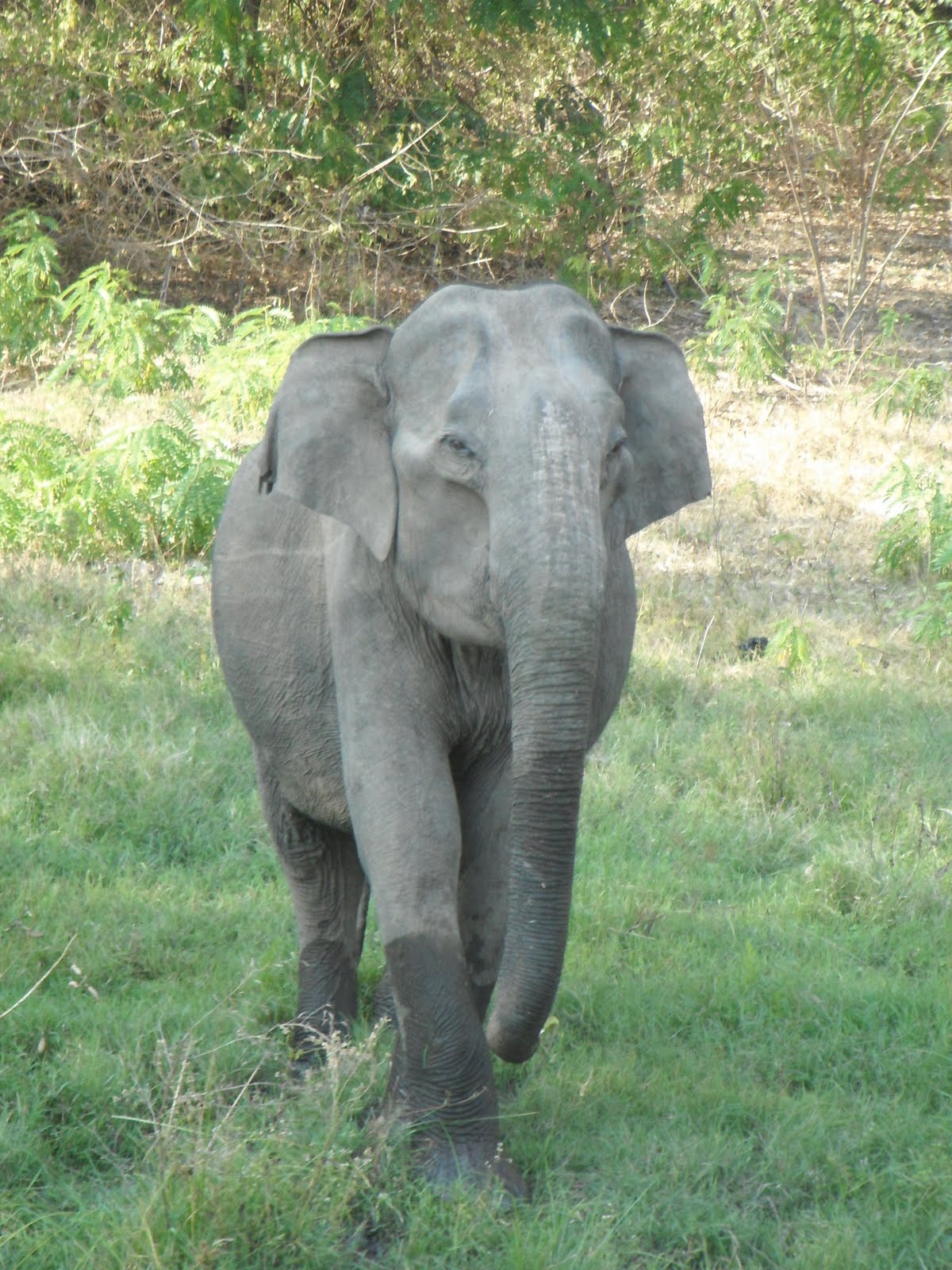
Wild elephant, Bandapur NP
Unwed monkey mother, Bandapur NP
Southern India is the more prosperous half of India. Many of the cities here are technology, medical and film industry centers. Bangalore, the city we flew into from Munich, is one of these places.  However, it was completely not what I expected.  Despite being a major city it was incredibly dirty, run down, chaotic and crowded.   Cars, trucks, buses, auto rickshaws, scooters and bicycles jammed the garbage-strewn, deteriorating roadways.  Hordes of people walked to and fro, doing business, going to work and selling their wares.  Women swept the mountains of rubbish along the street into piles to be picked over or burned.  Hundreds of feral dogs skulked along, pausing to scratch their sores.  Vehicles honked their horns to claim an impossibly small space to go through.  We gaped at this wild scene from our hotel window.

Spotted deer, aka tiger tapas, Bandapur
When we finally braved the streets we found more of the same on a much larger scale.  Bob, Doug's brother-in-law, had a friend of a friend meet us to show us around.  Sunil is a native of Bangalore working in the offshore medical billing industry.  He graciously spent the afternoon taking us to lunch, driving around the city to see the sites and to visit the summer palace of the Maharaja.

Below - Tiger video!


The driving, as in Italy and Greece, was an adventure.  However, this was on a much more intense scale.   The three of us were really glad we weren't behind the wheel.  I got laughing sitting in the back as I watched drivers trying to negotiate the traffic. I have long since stopped jamming my foot into the floor boards or gasping at the multiple near-misses.

WOW!!!! A high point of our trip
Kerala houseboats
Surprisingly, I am getting used to this.   As we wound our way through tiny streets we found ourselves marveling at the many ways life goes on.   All through our trip we have been struck by how people are living life just as we do but in different circumstances.  India is just on a more profound scale.  In India, day-to-day life is unmechanized.  There are people doing all the jobs we see machines do at home.  People sweep streets, carry heavy loads, dig ditches, move gravel or dirt from one place the next, plow fields, gather water, wash clothes, and on and on.  There are people to help you use an ATM and people to help you put your ticket in an automated turnstile.  One store had so many staff in it that there was little room for us.  Everyone has a job or position and is busy executing it.  All the activity is absolutely fascinating.  Despite the challenging visual assault, I really like it.  Doug looks like a scared animal most of the time, and Kate LOVES it.

Kerala backwater boats


Kate and our little boat

Afternoon coconut juice stop


The next day our driver, Prasanth, picked us up and drove us to Nagarhole National Park.   Nagarhole NP is a 650 sq km wildlife preserve established to protect India's rapidly diminishing jungles and savannas, and its wildlife such as tigers, elephants, wild dogs and leopards.   These are all being threatened by agriculture, industrialization, poaching and pollution.

Canal banks, Kerala
The drive down from Bangalore was intense.  With a few site-seeing stops and a late breakfast it took us 8 hrs to go 200km.  Getting out of Bangalore alone took almost two hours.  Freeways are non-existent and the roads are jammed with people, vehicles and life, even in the more rural towns.  In the rural towns, add more scooters, bicycles, cows and ox carts.  We all sat quietly taking it all in from the comfort of our air-conditioned car.  Our driver was a very nice Indian man who spoke some English but with a very thick accent.  We did our best to communicate but it was difficult.


As we got closer to the park, the land opened up.  The topography changed to more savanna with really beautiful open plains, distant mountains and acacia trees.  The towns became smaller and cleaner.  Cows were all over the place.  They seemed to prefer being in the streets or peoples' yards to being in the boring old fields.  Cows have the most right of way on the roads so we did a lot of weaving in and out to avoid hitting them.  Contrary to what we had believed, cows are allowed to stray but they are owned by someone and are pretty well taken care of.

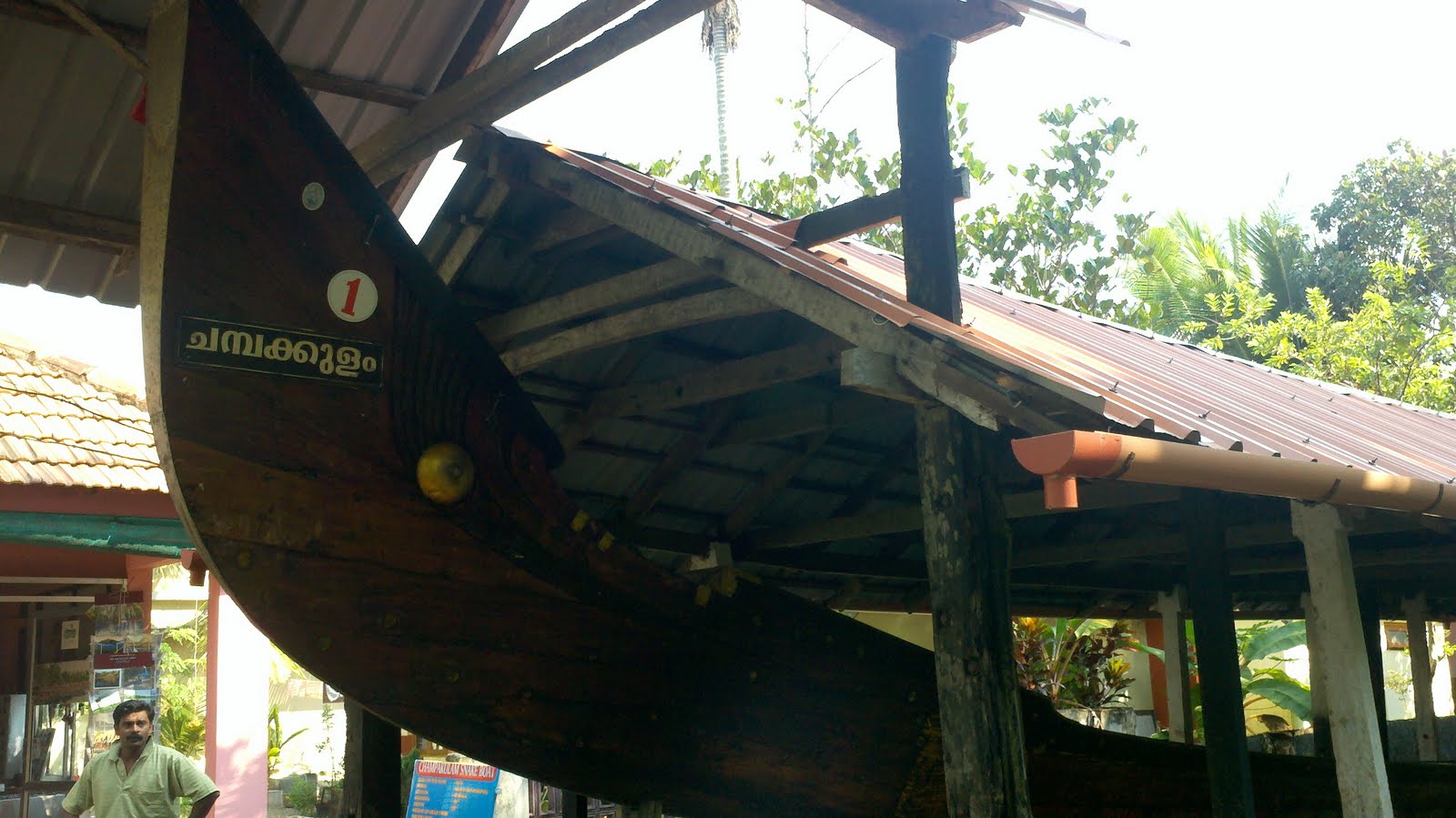
Stern of Kerala snakeboat

Another thing that struck me was the way people were dressed.  Almost everyone, no matter how poor were well groomed : Hair neatly combed and arranged and clothes clean.  99% of the women wear absolutely stunningly beautiful saris with gorgeous long thick black hair adorned with Jasmine blossoms.  They are like bright jewels among dusty brown.  Despite life being hard, people seem to be relatively happy and frequently smiling with the Indian infectious smile.  They are certainly friendly to us and incredibly gentle.

Bow of snakeboat
Detail of how the Kerala boats are lashed together
Once we got to the park we were very exhausted and rested in our very cool jungle cabin.  According to Lonely Planet guidebook, Goldie Hawn loves this place. It is quite rustic and way out there.  Had a good safari feeling to it.  We had great Indian food and saw a fabulous video on tigers and their plight.  The next morning we went on a jeep safari in hopes of seeing wildlife.  We did see some spotted deer, monkeys, a few elephants off in the distance.  No tigers though.  They are more active in the afternoon.  Unfortunately we had to leave that day as the lodgings were all booked.  So, after our Indian breakfast of dahl, rice, curried potatoes and chai, we had another fascinating 3 hr drive over to Bandipur National Park for the next two days.

Bandipur is a larger preserve covering 950 square kilometers.  It is more accessible, but still pretty remote.  The coolest thing was seeing THREE tigers!  We went on three jeep safaris while there and the first one proved to be the best.   Our jeep safari guide got wind of a tiger moving through the forest near us and we sped off to find a spot to intercept her.  Tigers move in very predictable ways so intercepting them is relatively easy.  The hard part is finding them in the first place.

Kerala
After many twists and turns, sage conferences with other jeep drivers and analysis of tiger paw prints, we waited and listened for about 1 hour.  Finally, we heard warning calls from the deer and monkeys that a tiger was approaching.  We all held our breath, poised our cameras and stared into the thicket from which the tiger was supposed to emerge. Sure enough, in about 1 minute a magnificent female tiger stepped out of the thicket and sauntered unfazed right across our path, up the opposite bank and down to a water hole.  We were all speechless and really excited.  Seeing her emerge from the thicket took my breath away.  Then, just as we were congratulating ourselves on our good fortune, one of her 16 month-old cubs walked out in front of us a little further up.  Our guide was totally psyched.

Hangin' on the upper deck for the afternoon
According to our guide, this female tiger had four cubs and they were probably meeting up at a waterhole.  So we sped off to the possible water hole and saw another one of her cubs.  This was from quite a distance but still, it was a tiger.  Finally, we had to head back as the park was closing for the night.  We were all exhilarated.  The next day, while not quite as exciting, we saw a leopard from a distance, lots of fantastic birds, monkeys and elephants.  One elephant had tusks and we were quite near him.  He raised his trunk to get a sniff of us and then got a little annoyed at us and started to crash around in the thicket.  We thought he might charge but he didn't.  That got the ole' heart racing.  So we saw three of India's biggies.  Also, there are only 1500 tigers left in the wild in the world and we got to see three of them.  Very cool indeed.

Indian schoolchildren being friendly
Early the next am we reluctantly left or jungle home for the fray of Bangalore as we had a flight to catch at 2:30 pm.  As we left at 5:00am we got to see India wake up.  As we drove through the early hours we saw oxen pulling carts laden with massive stacks of grass going to market, women gathering water from the local hand pump, people slowing filling up the sides of the roads to get on buses to go to work, and the shimmering Indian sun rising in the sky.  It was really quite remarkable.  Again, the colors of the saris, temples, homes, buses and trucks stood out among the brown.   The  Indians love to decorate their trucks and buses with brightly colored paints, tinsel and flowers.

Lunch! 
We made it to the airport with plenty of time to spare, especially since the flight was delayed two hours.  So we settled into the airport and processed what we had experienced the last few days.  Doug and I both have felt a wide range of emotions from complete euphoria to OMG get me out of here.  Kate has just loved it.  She doesn't understand why we would have any negative feelings.  Granted she has the luxury of sitting back as we stress out over the planning.  She has also commented that she thinks older people try to form opinions of everything and kids just take it in..........Hmmmmm, good point.  I am just trying to take it all in.  However,  we are going to put her in charge of researching and organizing Cambodia.  Give her a little taste of the organizational part of this trip.

Still smiling after a lot of driving!

Another Kerala houseboat - swanky!

Kate at the wheel

Taking bricks to a construction site

Schoolgirl's gift

Another gift

And still another
 Doug and I find that when we get tired we can't cope with the onslaught quite so well.   We have found ourselves feeling very disoriented at times.  While there is some semblance of familiarity, the whole experience is so foreign that it is hard to keep a grasp on it.  Minor things like, where does one buy toothpaste and contact lens solution feel insurmountable. Nothing looks or is organized the way we are used to.  We have been dealing with this on some level the entire trip.  But in India it is ten-fold.   Each day is approached with some trepidation but also with excitement.  It will be interesting to see how we feel after a month here.

Our flight took us to the SW coast to and Indian state called Kerala (care-eh-la) - really roll the rrrrs and lllllls and you have it.    It is considered the swankiest part of India.  It is famous for its incredible food filled with creative spices and fantastic fish.  It is also famous for its amazing backwaters.  We came for both.  We stayed in the grungy town of Cochin for one night and made a hasty retreat the next day with our driver.  We drove another hair-raising drive 2 hrs south to the center of the house-boat backwater tours.  We booked three nights on one to explore the rural side of India along the waterways and rice fields.

Another view of the snake boat
As I write this I am floating down a canal lined with palm trees, wild flowers, rice patties, native homes, fishing canoes, children running off to school, women washing clothes in the river, men diving for shell fish and men ferrying all sorts of goods to and fro.  Small villages appear out of no where.  Sometimes we stop to buy fish or just walk around.  The villagers come running up to shake our hands, smiling and saying hello.  Some villages have women singing the Hindu meditations over serious loud speakers so everyone can hear it.  It is a bit of overkill if you ask me.

One morning I walked off on my own for a bit and stopped to take in the view.  Three older people came up to me and motioned for me to come with them to see a better view.  While looking at the better view, which really was better, one of the women came out of her cement hut with a steaming bowl of Dahl and rice and freshly ground tamarind.  She motioned for me to sit.   I looked at it, took a deep breath and dove in.  (I was thinking about the antibiotics I had back on the boat and felt I had what I needed should I get sick.)

Houses along a canal
 The food was delicious and they all seemed very happy that I tried it.  I was a little rattled as I had to get back to the boat and I couldn't finish it.  I think I gracefully excused myself after a few bites and said "Namaste" many times to smiling faces.  I felt like I had just stepped into a National Geographic film.

K & J at one of our stops
One night we tied up near a hut with a family who came to see us.  The mother was holding a beautiful 2 year old child in a bright orange dress.  She spoke a little English so we could communicate a little.  She seemed eager to show us her house and meet her family.  Their house was a three-room dirt floor cement structure that was very primitive.  Her husband had lived there for 40 years. Her mother-in-law was on the front porch and looked very ill.  She apparently has very bad asthma and kidney problems.  Medicine is too expensive and traveling to the doctor is too difficult for her.   She sleeps on a mat on the porch for cleaner air.  Also the little girl goes to physical therapy for a frozen shoulder injured during delivery.  As you can imagine the nurse in me kicked in and I started to examine the shoulder of the girl.  I told her mother I was a doctor, way easier than "family nurse practitioner".  Heck, even people in the US don't even know what an NP is.  She was very appreciative of my attention and my approval of her PT progress;  the little girl was doing very well.  As for the mother-in-law, that is another matter.  I have decided I want to start a medical house-boat in the backwaters of Kerala!

Relaxing on the boat
We spent three incredible days floating all over the backwaters.  Our boat was about 50 feet long and covered in a bamboo frame tied together with coconut fiber roping and covered in a palm-leaf weave.   It was one bedroom, so we crammed in.  We had a personal cook and driver.  We also had the BEST Indian food we have ever encountered.   Kerala's cuisine is the best in India!   We ate way too much.  My hopes of losing weight in India have rapidly vanished as I can't resist this amazing food.  Our boat felt very luxurious, which also felt a little weird given the poverty around us.  I'm not sure how to process that dilemma.  I just kept thinking that these house boat tours are a good livelihood for many people living here. So we are contributing in some way.

After the houseboat tour we headed back to Cochin to catch our overnight train to Chennai, formerly Madras.  Our second time in Cochin proved to be much nicer as we toured the old town and actually got to get out of the car and walk around a bit.  We are finding it very hard to do anything but sit and ride in India.   Walking along the side of the road, even in the towns, is very dicey.  We have seen almost no Westerners on the roads.  In Cochin, we insisted our driver let us walk to the inner part of town after lunch.  He looked at us like we were nuts.  It was a good walk and we felt more connected to our surroundings as well.

Folklore museum in Cochin - excellent!

Detail of the entrance to the folklore museum

We got to the train station for our overnight train to Chennai and waited for our first train experience in India.  I think it may be our last.  Doug was completely grossed out at the train station bathroom.  He thought he might throw up from the stench.  The station was filthy as is everything in India. I really don't understand why this is necessary, especially in public places.  The toilets on the train were pretty horrific as well and we are traveling the next level down from first class, called "second AC sleeper".  This means that you get an air-conditioned berth and a curtain.  It comes with "clean" linen and a blanket.

"Chinese" dip nets, Chochin
 Since the compartments are not secure, you have to sleep with your luggage close to your side.  We all slept fitfully but well enough to function the next day.   In the morning when we were waiting for our train to arrive, a woman scooted by on her tush with her little boy following along, sweeping the floor.  We gave her a tip.  I think this may be the only cleaning the train gets.  We really need showers.  Later, Kate and Doug realized they had gotten flea bites on their feet while on the train.  Doug was awakened through the night by cockroaches running over him.  Even Kate had to admit this was disgusting.

Despite the above, Kate loved the train and Doug and I really didn't mind it too much.  As long as I didn't have to spend days on one.  Using the trains to see the countryside is kind of useless as the windows are so dirty you can't see out.  Perhaps riding on top really is the best option.  A wee bit dangerous though.  We haven't seen anyone riding on top of the traincars since we've been here.

Church where Vasco de Gama was buried
We are finding that we have to lower our expectations a lot.  What we imagine as first class would be better described as "minimally acceptable."  Even the houseboat, that was supposed to be a premium boat, was a bit grungy, had no hot water and only had facilities for a sponge bath.  Kate slept on the floor on an old tattered mattress at the foot of our bed.  No complaints from her, bless her heart.  She has never complained on this entire trip.  She has totally embraced it.  We have yet to see anything that looks like first class to a Westerner.

How the trains are put together - Cochin station
Even so, the jump from first class to the next level down is huge.  Second class often means filthy and broken.  You have to have your India survival kit with you at all times: a bag with toilet paper, hand sanitizer, wet wipes, coins or 10-rupee notes for tips.  (10 rupees is about 20 cents), sealed bottled water, snacks that you trust, (i.e.: cooked), and a lot of good faith and open-mindedness.  If you have that, you can relax and enjoy all the wonderful things this place has to offer and there is much to love.  As Bob Burleigh said to us, "Welcome to India. Now embrace it!"  Okay, Bob - we're trying!

Kate in her railway berth
We have just pulled into Chennai.  I will stop here and send this off.  It's a long letter but I hope you found it interesting and have a sense of what we have been experiencing.   I will stay in touch when I can.  Internet access is spotty.