Sunday, September 18, 2011

England!


We have been to Britain a number of times since 1975, each visit separated by many years.  The country has changed a lot.  The southern part of the country seems more modern and international than previously – there’s no sign of the frayed drabness of the Seventies.  Doug met Paul and Michele
Paul striking a heroic pose on his steed
White, our hosts in Hampshire, during his Junior Year Abroad at the University of Wales in 1978-1979.  We’ve always been honored by their friendship, their tremendous positive outlook (and their patience with Americans!)  Their sons Isaac, 18 and Ben, 21 have all the positive characteristics of their parents and it will be a pleasure to see what they decide to do with their lives.

Paul and Michele's house in Ringwood is a short drive from Queen Mary II's berth in Southampton.  We dropped all our gear in our guest rooms and went out immediately for a long mountain bike ride into the New Forest.
Jenny and Michele deciding what's what
By coincidence (surely!) we soon came to a fine pub where we felt compelled to pause for refreshment.  We sat outside on a fine afternoon and enjoyed a pint of good local ale.  There’s no better welcome to Britain than that.  Except another pub a few miles on through the forest!
Isaac, our enthusiastic host and Very Fine Fellow
The New Forest is a national park within walking distance of Paul and Michele’s house.  It has existed as a preserve since 1087 when William I (you know, The Conqueror) decided the area would make a good hunting retreat.  Prior to that, according to Wikipedia, the area was known to the Romans as the Forest of Spinaii and to the Anglo-Saxons as the Great Ytene Forest.  “Ytene” meant “Juten” in reference to the area’s settlement by the Anglo-Saxon Jutes from the area known today as Jutland in Denmark.  In the forest we passed what is thought to be the remains of a royal enclosure, or regular campsite, where William came to hunt.   Though it’s nice to think of all those millennia of conservation-minded people caring for the Forest, in reality the soils are so poor there wasn’t much else to do with the land.

House in the New Forest
Kate loved our bike rides

The New Forest is as much open meadows covered with heather as it is forest.  The land is gently rolling and perfect for walks, horseback riding and mountain biking.  The woodlands have traditionally been managed for timber but are being restored in several places to the original mix of hardwoods for improved habitat.  On one of the days we biked we saw the brilliant carpet of heather glowing under a dark grey sky as if the flowers were lit by a black light.  It was marvelous to see the heather in such extravagant bloom.


Our two weeks with the Whites quickly settled into a mix of visits to historic sites and rest days of journeys into the Forest or hikes along the chalk cliffs of Hampshire and Dorset.  Almost every day ended with a feast that Michele seemed to conjure effortlessly.  We hope our hosts were as comfortable with us as we were with them!  Our visit was relaxed and perfect.

Our first full day after arrival we drove to Bath to see the Roman baths and some of the magnificent Georgian and Palladian architecture that surrounds them.  Each time we have visited Bath we have seen new aspects of the archaeological dig and new interpretations of what’s been found.  As previously, we were struck by the worn steps of the temple of Minerva (Athena), patron of the baths, and by the striking bronze bust of the goddess herself that was found among the ruins.  Another favorite is the selection of requests Romans wrote on small lead sheets and tossed into the sacred spring for the gods’ review.  The faithful wanted everything from good luck on upcoming journeys to the gods' revenge upon personal enemies.  The requests seem very familiar in their tone and bring the people of that period to life.
Minerva!
  
 
              The Roman plumbing still works - Bath


Visiting a sculptor's workshop in Bath

England’s history is as layered as the sediments in the Grand Canyon.  Centuries of relative stability would suddenly end, wrenching into new eras.  The 400 years of Roman occupation following Caesar’s invasion in 54 ACE is sandwiched between two essentially prehistoric  periods – that of the Celtic Britons prior, and that of the Angles and Saxons after the Romans withdrew.  You can’t help feeling a bit sorry for the "original" Celtic Britons who themselves were settlers from the Continent after the ice sheets withdrew.  They were either absorbed by the Romans or pushed into present-day Cornwall , Wales and the Lake District of North England, where their descendants can still can be seen as sometimes darker and shorter than other English people.

King Paul I enthroned at Winchester
When the Western Roman Empire collapsed in 449, the Romans were soon replaced by colonizing Angles and Saxons sailing over from what is now Belgium, Holland and Denmark.  These new invaders hadn’t had any exposure to Roman culture and certainly had no interest in baths.  They thought the Roman buildings, bridges and roads they encountered had been built by giants.  Before they could get fully settled in the eastern part of the island, the Angles and Saxons were pressured in turn by raids from their even less-civilized cousins the Vikings, who ravaged the coasts of Europe and later took over large portions of northeast Britain.

Great Hall at Winchester w/ Round Table on the wall
 The Vikings, or Norsemen, spent so much time raiding the northern coast of what is now France that the Frankish king made a deal with them to create Normandy, their own duchy, if they would stop being so belligerent .  They happily accepted but continued raiding along the coast.  When William, Duke of Normandy, landed in England he was really going to war against his Scandinavian cousins.
 
William’s invasion has never been successfully repeated.  The most significant efforts were the Spanish Armadas during the reign of Queen Elizabeth I and World War II.  Until the French finally drove the English out of France at the end of the Hundred Years’ War in 1453, the kingdoms of England and France draped across the Channel.  They were based more on feudal relationships than on geography.

Norman transept with view of newer Gothic beyond at Winchester Cathedral

One of six chests containing bones of Saxon kings - Winchester
When we went to Winchester we were taken aback by the depth of its history as the long-time capital of England.  The castle is mostly gone but the beautiful timbered Great Hall remains, having been a center of English law from the time of William until just recently when the courtrooms were moved to a modern, laughably boring facility next door.  Henry II’s version of King Arthur’s Round Table hangs above where kings and judges heard petitioners for over 800 years.  Henry II was a great lover of the troubadours and the romantic tales of the 12th century.  He had the table built as a way of celebrating Arthurian tradition and appropriating some of its mystique for his own reign.  When the greatest appropriator of all the Henrys, Henry the Eighth came along, he couldn’t resist painting the Round Table with a Tudor Rose and his own face as Arthur’s.
 
Michele kept smiling no matter what
Paul and Michele set up a Shakespeare play at Stratford-upon-Avon.  Thanks to Michele, we were able to get tickets for Macbeth, performed by the RSC.  Wow!  Not only was it spine-tingling to see the play in Shakespeare’s home town, it was a very good production.  We recognized several of the actors from movies such as "A Knight's Tale" and "Prince of Persia".
 
Oxford the next day was a real pleasure.  Thank goodness Paul and Michele were willing to drive!  British drivers are clearly better trained than Americans, but there are a lot of them.  The traffic was intense.   Nine dollar gas doesn’t seem to keep people off the road.

Oxford student dive bar for 800 years or so
The University makes up almost the whole of central Oxford.  We were loath to spend $10 a person to enter each of the colleges, so we peeked through the gates at the gardens and enjoyed the splendid gold-colored stone buildings.  The streets were thronged.  At one point Kate got a little too enthusiastic about looking into one college. She got her head stuck between the bars of the gate just as an elderly couple arrived wanting to go through.  We freed her and had a good laugh, teasing Kate that Oxford didn’t admit students who failed this basic intelligence test.  As always she was a great sport and laughed as hard as we did.
  
When Paul wasn’t feeling well one day Michele took us to Salisbury and Stonehenge.  The cathedral is looking very spiff after a major overhaul.   Much of the original painting has been restored, giving the interior warmth and energy it was missing after being whitewashed by some stuffy bishop in the 1700’s.  We also liked the energy shown by the cathedral community in the art installation and presentations about the cathedral community's human rights activities around the world.  This kind of vitality is critical if the Anglican Church is going to survive in its homeland.  At present, less than 20% of the English attend church of any kind.
Salisbury Cathedral is home to one of four remaining copies of Magna Carta, the foundation document for all the constitutions to follow.   Old King John really was a rat - he asked the Pope to rescind it shortly after signing, and the Pope agreed.  It is written beautifully in Latin shorthand on vellum, the skin of a calf’s belly. The script compresses at the bottom where the scribe realized he didn’t have enough room to keep everything to one page.  Magna Carta  is displayed in a very accessible case making for easy viewing.  A cheerful elderly lady guards it and is happy to tell stories about King John's perfidy and Magna Carta's eventual triumph.  We were all impressedSalisbury town is beautiful as well.  Many medieval buildings complement the cathedral.

Stonehenge is just up the road.  Like all other major attractions in Britain, it now charges a steep entry fee. We were able to get a good look from outside the fence.   All the stones seem back in order after Clark Griswold knocked them over in "National Lampoon's European Vacation."  The stones, at once kind of silly in their position at a fork in the road with lots of traffic zooming by, are also enigmatic as a reminder of the length of human habitation in England.  In 8,000 years the English have been pretty good stewards of the land.  We also took a look at the archaeological work that's radiating from the henge to the surrounding fields and includes many burial mounds, a broad processional avenue and several straight intersecting lines about a mile long.  We had not known that some of the largest stones, weighing up to 65 tons, were brought from a quarry in Wales 3,000 years ago.  The trip involved crossing the Severn River which was no small feat.

On our “down” days we hiked the coast at Christchurch, Durdle Door, Lulworth and some other small towns nestled in the green hills near the sea.  The weather held beautifully for us and we got to see where the Olympic sailing events will be held near Weymouth.  The south coast has a wealth of beautiful hikes.  One evening we all drove to Bournemouth to see fireworks over the harbor.

A walk along the coast, Dorset
 One of our days ended at Corfe Castle.  This Norman stronghold was ordered blown up by Parliament during the English Civil War in the 1640's.  They must have used some serious gunpowder  and undermining because huge chunks of the walls and keep lie on their side.  Enough remains in tale and stone to be an exciting place to explore for 13 year-olds of every age.  The dark shadow of King John extends here, too.  When Maud of Braose angered him, he had her and her son walled up in the dungeon of Corfe Castle, where they eventually died in the cold darkness.
Kate emerging from "murder hole" at Corfe

On  a more cheerful note, we celebrated our 25th wedding anniversary on August 16th with a lovely bike ride through the New Forest and with Champagne and a fine dinner with Paul, Michele and Isaac.  Our entire visit with them was simply smashing.  We can’t wait to reciprocate when they come to visit us in the US!
All too soon we had to pack up our gear and hit the road.  Since British Rail was privatized, it’s become prohibitively expensive to take the train on most routes.  Luckily the bus system has expanded to take up the slack.  In the drizzle of an early morning on August 18 we said a sad goodbye to Paul and Michele and caught an early morning bus from Bournemouth to Ipswich.
 
Tony, Wendy and Verity Poulston were our next hosts in the little village of Felixstowe in Suffolk on the east coast of England.  Their daughter Verity and Kate had shared 4th grade at the Ashwood Waldorf School in Rockport, Maine when Tony and Wendy were in the US for a year.  Tony develops computer software for predictive currency trading and Wendy performs and teaches music.  We’d kept in touch and thought both Kate and Verity would enjoy some time together.  They picked up right where they left off, and so did we four grownups.
Kate and Doug with Verity, Wendy and Tony Poulston, Kentwell
The afternoon of our arrival we toured the waterfront in Felixstowe, which is very modern and the busiest port in Britain.  As some rain moved in we stopped for a pint in an old pub by the seaside.  Felixstowe is quite small considering the amount of freight that it handles.  Just outside town the gently rolling countryside resumes with nice walks everywhere.
 
Doug was delighted to hear that the Saxon burial site of Sutton Hoo was nearby.  ("Shouldn’t that be 'Hoom'"? he wondered.) In the 1920’s a local woman had decided that the amateur digs in burial mounds on her property needed some professional guidance.  She hired an archaeologist to do some digging of his own.  He quickly realized that he was onto a major find:  a complete, undisturbed burial of what appeared to be a Saxon king from the 7th century.  The king, believed to be Raedwald, was buried in a chamber beneath a 90-foot Saxon ship.  The ship was entirely decayed, but the iron nails and outline remained in the soil. Later, when we were in London, we visited the treasure at the British Museum.  It includes a war helmet, a royal silver service, a king’s sword and many finely wrought gold objects. 

Part of the Sutton Hoo treasure, British Museum
At Sutton Hoo (Sut = South, ton=town, Hoo=hill) we walked the field where the discovery was made and got a good sense of what the land was like at the time of the burial.  Getting a 90-foot oak ship up the hill from the river must have been quite a task.  Researchers are working to locate the site of the royal hall which they know must be nearby.
 
The evening of August 19th we were treated to more Shakespeare.  This time it was Twelfth Night performed by a professional company in a forest.  It was an excellent production, having just the right amount of Shakespearean zaniness.   The children in the audience laughed uproariously.  Behind us, we heard a child excitedly explaining to his father what was happening in the play.  Shakespeare would have been very pleased.

On our last day with the Poulstons we toured Kentwell, a Tudor manor house in the Suffolk countryside.   It is owned privately by a family that has been working to restore it for decades.  Much of the original house is intact, including the kitchen.  We were allowed to wander through without supervision.  It’s one of those places you immediately want to live in, and in which you can readily imagine the life of the original residents.  Kate and Verity got a kick out of the voracious carp that fill the moat.  The fish gather in a great roiling mass anytime a person approaches.  We made up voices for them as they gaped at us from below the bridge.  A duck practically walked over the fish as it maneuvered for any possible scraps of food.

Creepy carp frenzy at Kentwell

Kentwell Tudor manor house

Fanciful topiary, Kentwell

Kate gets pilloried - "stocks" are for feet


Glam girls ready for London!
Our stay with the Poulstons was also filled with eating wonderful food, drinking wine and ale and playing many of the musical instruments that fill their home.  Kate and Verity wrote and performed a rather bleak song of love and rejection that's still awaiting a title.  "Get lost, loser!" might work.   All of the Poulstons, including their oldest daughter Miriam, are very musical so they had lots of instruments to choose from.  Doug played his heart out on a sand-filled egg mariachi and a wooden frog to provide percussion.  Wendy played the piano and viola, Verity was on violin and sax, Tony transformed a cello into a stand- up base, Kate switched between piano and guitar, and Jenny played guitar.  It was quite a jam session.
All too soon we had to get on the train for London.  Verity thought it might be fun to accompany us, so we four went ahead.  Tony and Wendy would follow in a few days because they were due to pick Miriam up from her summer working in Dorset. 


Monday, August 15, 2011

New York, New York and QM2

NYC and QM2

We knew we’d had a good visit in Maine when we began to get itchy to move on.   As much as it was hard to leave we were ready for the foreign part of our adventure to begin.  Saturday July 23rd we got an early start for the train in Portland which would whisk us along to Boston and then NYC in eight short hours.  Jenny’s stepmom Gray accompanied us to New York for our four days there. 
The way to travel - on the train to NYC
The train was a very good alternative to driving.  We were able to read, nap and chat the whole way without having to deal with the dense traffic on the freeways.    For those of you wondering, we did successfully sell our big gray Toyota Sequoia to a lovely family in Maine.  We hope they are happy with it.
 
Once at Penn Station, we joined the mob coming up to street level and grabbed a taxi for the short drive to the apartment we rented on W. 60th near Central Park.  It was exhilarating to feel the energy of the city.  The apartment was on the 25th floor and had an excellent view uptown.  We got it through Airbnb.com.  Between the information left by the woman who owned the apartment and Gray's experience with NYC, we were never at a loss for things to do or places to eat.

Kate and Grandma on the Circle Tour
Our plan for NYC was quite open.  We did some shopping, as Kate and Jenny needed some fancy duds for the QM2.  We strolled around Central Park where we saw a Peregrine falcon preening itself on a lower limb of a tree on Cedar Hill.  It looked quite plump from its diet of pigeon.  Nearby, a raccoon made its way determinedly down a tree despite several onlookers - another fearless New Yorker.  We also ate at some wonderful restaurants.   Two faves come to mind:  Dawat, an Indian restaurant, and a lovely little french bistro that had amazing quiche and French onion soup.   

We had a great visit and dinner with Lisa Stifler, her husband Ray O'Hanlon and their son Jack, who's Kate's age and a live wire.  Lisa was a classmate of Doug's from Bates.  We met them at a wonderful Irish pub for some great snacks and pints of Guinness.  Afterward they showed us around lower Manhattan and the Financial District.  The canyons of Wall Street and Ground Zero were memorable.
Thank you, Gray for treating us to a wonderful evening out, including Phantom of the Opera! Another of her ideas was taking a cruise around Manhattan.  It was a great way to see the city and get our bearings.  Jenny and Kate got their first view of the Statue of Liberty which was very impressive.   Our last day there we walked down through SoHo to Chinatown, Little Italy and had an excellent lunch at Union Square Café.

Our impression of NYC was very favorable.  The city was cleaner, the people more friendly and getting around was a lot easier than we expected.   Kate has decided she wants to move there for college.  She thought the energy was great, and has already been shopping for apartments near where we stayed.  Now that's thinking ahead!

"I lift my lamp beside the Golden Door"
View of Manhattan from the QM2 in Brooklyn

On the morning of our departure on the Queen Mary, we said a happy and sad goodbye to Gray.  She zoomed off in a taxi to catch her flight and we went back to the apartment.  We started missing her right away.  We gathered all the gear that we’d strewn around the apartment and were dismayed to find there was even more than before!  We hadn’t pinched any of our host Amy’s things, either.  We’d done some shopping but it couldn’t account for the bulging luggage we rolled down to the lobby.  We promised ourselves that we'll REALLY cut back once we get to Britain. 

QM2 in Brooklyn
Kate and Jenny on the Deck 7 promenade

Homer Simpson hidden on a QM2 bronze frieze
Since checkout was 11:00 and we didn’t have to be at the ship until 2:30 we hung out at the Time Warner center on Columbus Circle.  At the big Borders store we joined other book vultures, checking out the sale prices on their liquidation.  Our hearts went out to the employees, who were pretty downcast.  We didn’t have an answer for Kate’s question as to why they were going out of business though our impression is that it was more a case of poor management than the growth of the Internet.  Maybe some of both.


After dossing about for a time we decided to head out early for the ship, as we knew they would be boarding all afternoon.  Our taxi ride took us down the expressway along the west side of Manhattan so we had good views of the city and the huge new structures going up at the World Trade Center.  We zipped over the Brooklyn Bridge, descended into a maze of streets around the Brooklyn Cruise Terminal, all the time being teased by views of the mighty ship.


It is big.  Our taciturn cab driver became very excited when we got close, asking all kinds of questions about where we were going and oohing and aahing.  If you can impress a New York cab driver you’re doing pretty well.  We constructed an embarrassing heap of luggage in front of the porters, smiled weakly at them and plunged into a warehouse-type building where we went through a security check, passport check, ticket check, credit card check, photo opportunity and finally toiled up a zig-zag stairwell and ramp to a garage-door sized opening in the side of the ship.  The lighting and the décor made an instant strong impression of comfort and grandeur.  We were ready to be wowed.  The double line of crew members welcoming us aboard was a nice touch.

One half of the view from our cabin
We were directed to our cabin by crew at every turning.  Once inside, we were relieved that it was large enough for three of us.  The outside sitting area was accessed through a large double glass door and had a wide opening to fresh air over a varnished wood railing.  We cracked the Champagne that had been waiting for us in an ice bucket on the coffee table, leaned on the rail and took in a majestic view of Manhattan, Governor's Island in the foreground, Ellis Island and the Statue of Liberty off to the west.  Sweet!

The ship has 14 public decks and a few more below those.  We were on deck five, so once we were underway we were close enough to the water to hear it hissing past the hull.  The spaces aboard have been designed to avoid an impression of overwhelming size.  The corridors are long, but the public spaces are appropriate to what you would expect in an ocean liner, not a shopping mall.  The dining areas are roomy.  Cunard did an excellent job creating a liner that has the comfort and stability of a very large ship without the negatives of cavernous, unattractively large spaces.  Well done!

Even the guys directing traffic stared at it
I had been skeptical of the distinction that Cunard makes between its liners and regular cruise ships.  Basically, liners are heavy-duty so they can hold up to the rigors of frequent ocean crossings.  There's another distinction, however.  On a cruise, the ship itself is the destination and needs to have a plethora of activities for the passengers, much like a resort hotel.  On a liner, the activities are a complement to the journey.  The ship is transportation – luxurious, yes – but still transportation.  A liner is equipped with quieter activities that accompany an actual passage to another place.  There are lots of deck chairs, lounges for reading, books, movies and music.  The only gizmo that to me seemed out of place was the planetarium until it was explained that it was on the ship due to the connection between seafaring and the stars. We got right into shipboard life.

Spare propeller blades for the ship's drives
The vast top deck

Silliness on the (chilly) promenade deck

The corridors were super long


Our table

On the Grand Staircase

A whole bar dedicated to Veuve Cliquot! 
We spent our days reading, walking laps around the ship and snoozing.  Jenny and Kate took watercolor classes and we all worked out in the gym.  We appreciated the size of the Atlantic Ocean as for six days all we saw was water, seabirds, water, porpoises, and more water.  The seas were mercifully smooth all the way across.  When our arrival in Southampton rolled around we were torn by our desire to continue the relaxing life aboard and our desire to see our friends Paul and Michele, their two fine sons Isaac and Ben, and some of England.   

On Wednesday the third we woke up at around 4:00am to see navigation buoys going by from our balcony.  As the sky lightened we could see land off in the mist as well as some tugs coming out to accompany us into port.  We went up the east side of the Isle of Wight into the Solent, past Portsmouth, the historic headquarters of the Royal Navy.  The great ship made a few sharp turns as we headed farther into the estuary that leads up to Southampton.  We wondered if the crew would be able to tie up by 6:30, the scheduled arrival time.  By golly, the dock lines were thrown at 6:30am sharp after an impressive display of turning the great ship in a very confined space.

Tied up in Southampton
We chose to disembark on our own instead of having the porters help us so we could meet Paul and Michele as early as possible.  We left the ship excited for the next part of our journey but with great memories of the past 2 months crossing the US.  Thank you to all our friends and family who made the beginning of our trip so wonderful.  England, here we come!


Wednesday, August 10, 2011

You can go home again. PA, VT, ME June 25 - July 23


Guy and Jenny enjoying a fine afternoon
Traffic around DC is a huge barrier to getting anywhere.  We therefore waited until Saturday morning to make the run to Doylestown, PA where Jenny’s sister Wendy and her husband Guy live.  We’ve always admired them for their priorities.  They’re that rarest of subspecies of Americans – ones who live within their means!  They have stayed in and steadily improved a small house while being able to travel and play.  We’ve always had a great time with them, wherever we meet up. 

Wendy had a coffee house concert Saturday night that we made sure not to miss.  She’s been pursuing her dream of being a professional musician full time for the last year and is having good success.  Her band is very tight.  Guy was sound man and stage decorator.  The show was a good display of Wendy’s considerable chops as a musician and lyricist.  An added plus was getting to spend some time with our niece Amy, who just got a new position working with at-risk kids in Reading, PA.
 
Sunday we caromed an hour southwest to Doug’s sister Carol’s house in West Chester, PA.  As always, we had a wonderful time talking, walking and devouring Carol’s husband Bob’s fabulous cooking.  They have made a beautiful home of a house Carol and Doug’s grandfather built in the late 60’s.  We had two nice walks with Carol along the Brandywine River on a new section of a rails-to-trails project on an old trolley line that ran from West Chester to Downingtown.

One of the highlights of our visit was seeing Doug’s cousins Sally and George Mohr who live near Carol in Coatesville.  Sally’s just shy of 90 and George is 91.  All Doug’s life and our married time together, Sally and George have been benign and wonderful mentors.  It was great to see them still having fun together.  We had lunch at a little restaurant that has made a name for itself at a local airport.  One of Sally and George’s daughters, Cindy Wolcott, was able to join us along with her daughter Sarah, who’s going to Trinity College in Hartford in the fall.  They were just back from a cruise in Alaska.  Sally and George have always been travelers, so they were excited for our journey. 
The Hudson River at Nyack
 
Our next major journey was to  Vermont, where Jenny’s family was gathering for a reunion.  On the way we stayed at Wendy and Guy’s again and did some shopping for the trip.  Thursday we drove to Guy’s sister Pam’s in Nyack, NY to visit and to shorten up the drive on Friday.  That evening we went out to a good Italian place and drove around town a bit.  Nyack is an old Hudson River town that was nearly wrecked by the building of the Tappan Zee Bridge and the Interstate highway approaches to it.  What has survived is a bedroom community for NYC and a sweet collection of beautiful buildings stretched along the river.  

July 1 saw us up early for the drive to Vermont.  We left at 6:00am in the hope of avoiding traffic and reaching the town of Greensboro in the far northeast of the state by noon.  We were struck by how long the drive in Vermont was.  The Green Mountains that give the state its name were beautiful and welcoming. 

Our moss-covered digs at Brown's Circus, Greensboro, VT
View from the picnic spot on Barr Hill, VT
Kate with a rooster sculpture that appears mysteriously all over Greensboro
For the next week we swam, walked, sailed, picnicked and gabbed with Jenny’s  wonderful extended family.  It was the first time since Jenny’s dad passed away in 2003 that the four Bell sisters, Carey, Wendy, Polly and Jenny were all in the same place.  All their kids were there also, with the exception of Ian Lawson who was away at camp.  The weather was superb.  We kept up our record of no rain so far on the trip, the exception being some thunderstorms late at night.  

By the time July 7 came around, we were looking forward to getting to Maine to see friends and family there.  The drive over from Vermont to Maine is slow.  There is no real direct route.  It felt great to make the drive once more and to see that nothing had really changed along the way. 

Silliness on the Lake
The next 2 weeks we stayed with our friend Phil Brown at his house in West Rockport, very close to Camden.  We spent the first several days with Phil and his girlfriend Mary Ellen before Phil headed out on his own trip to Alaska via motorbike.  We house-sat for him for a week after he left. 

Kate was thirsty for more kid time.  She did a three-night camp out on a friend’s island on Lake Megunticook with Elyssa and Rachel Bower, Alissa Eddy and Vivian Priestley.  They kayaked out with all their gear and spent the next two days having a blast swimming, paddling about and just hanging out on their “Haven” island.  They had done something similar the summer before and showed much more ability this time around in taking care of themselves.  They’re growing up very fast, but all are having a lot of fun in the process.
 
On Dick and Ula's trimaran "Flying Circus"


Doug, Bruce, Cathy and Jenny aboard "Heron"
We knew we wouldn’t be able to visit everyone we wanted to see, but had committed to having as relaxing a time as we could.  We managed to get out on a sail with Dick and Ula Cadwallader and their daughter aboard their trimaran as well as a sail on the schooner Heron with our friends Bruce and Cathy Cole from Hawaii.  Cathy lives in Camden while Bruce lives in Waimea.  They get together every several months.  Their family is stretched out even further by their daughter Kate, who lives with her husband and new daughter in Spain.

Another highlight was visiting with Scott Dickerson and Janet Redfield, two friends who bought and protected Doug’s stepfather Clarence’s farm after Clarence passed away in 2004.  Scott and Janet have built a house on the property and have created a garden that is truly awesome.  The vegetables seem like mutant versions of their normal counterparts.  We had a very fine evening touring and then eating the fruits of their considerable labors. 

Visiting Maine after traveling from the eternal summer of Hawaii makes for a very different experience.  When you live in Maine, the summers are painfully short.  Instead of being a time of repose with much time spent on the porch with a glass of iced tea as it was growing up in Pennsylvania, summer in Maine can be a stressful time of getting the garden to bear, getting maintenance done on the house and readying for the long cold time.  We loved our time in Maine this summer and laughed that, if we hadn’t lived there already, we would be saying “Let’s live here!”  It surely is a beautiful place.  If we go back there we will have to do better at embracing every season.  

Sunday, July 17, 2011

Lost in America with Mom and Dad - the Very Definition of Boredom!
Posted by Picasa

Back East. Way back. VA & DC

In the gardens of the Governor's Palace, Williamsburg
June 19 saw us on our way from Raleigh-Durham to Jamestown and Williamsburg.  On the way we decided to take a shortcut and cross the James River to Jamestown via a ferry from the town of Scotland on the south shore.  The lowland country along the way was beautifully green.  Tall trees shaded the back roads.  It was a nice way to approach the historical sites.  For over 400 years the folks in these parts have taken pretty good care of the land, if not of each other. 


Why can't I get them to do this at home?  Mixing clay for bricks.
Jamestown was the first permanent English settlement in North America.  In 1607 an intrepid party of men chose a little island at the side of the wide James River on which to establish a town that in many ways was the direct antecedent of the United States.  Though poorly sited in terms of fresh water and good soils, the flow of settlers was just strong enough to overcome the horrible early years of disease and starvation.  Jamestown was the capitol of Virginia from 1616 until 1699 when the government offices were moved to Williamsburg to make travel to and fro easier as settlement expanded west.  As the fastest news could travel to England and return in no less than 6 months, the Crown had provided for limited self-government.  The progression to full independence seems inevitable from that humble beginning.
 

Kate devours an historic Olde Turkey Legg at Williamsburg.
That bird must have stood 8' at the shoulder.

Williamsburg was a thriving town until 1780 when the capital was again moved, this time to Richmond.  Then-governor Thomas Jefferson worried that Williamsburg's location was vulnerable to attack by the British, but its location was already losing favor as the center of settlement moved westward and people relied more on rivers and canals for travel.  Jefferson was prescient, considering the final showdown of the Revolution occurred the next year at Yorktown, just a few miles away.  The town continued to thrive as a regional hub until the Civil War, when it suffered damage from the Union assault and occupation from 1862 to 1865.  Despite the reopening of William and Mary College after the war, the town snoozed until the early 1900's when several local leaders realized the value of protecting the many buildings that survived from the Revolutionary period.  Luckily, John D. Rockefeller and his wife Abby Aldrich Rockefeller agreed, to the tune of $60 million.

We spent a day walking among the restored and rebuilt buildings in the historic area.  The broad gravel avenues and shady trees give a fine impression of what life was like at the time of the Revolution.  We were aware that there was a lot more work going on back then than there is now, and much of that work was being done by slaves.  The historical interpretation being done at Williamsburg emphasizes the role of slavery and the way in which it made its insidious conversion from indentured servitude - work for passage across the Atlantic - into "chattel slavery", the perpetual enslavement of people and their offspring that was in place in Virginia by the mid-1600's.  Like so many great wrongs, slavery was the product of many seemingly innocent adjustments in the 50 years after Jamestown was founded, such as recognition of different rights among English-born colonists, foreign-born colonists from different lands, Christian and non-Christians, and so-on.  Once the bonanza of tobacco production was in high gear, all niceties were set aside in favor of drawing in as much forced labor as possible.

Later, the emphasis on slavery continued at the US Capitol, where we were surprised to learn that the building was constructed largely by enslaved people, even as the Civil War was being fought.  President Lincoln believed continued construction would be good for morale.  Enslaved people continued to work on the Capitol at least until the Emancipation Proclamation of 1863, which, interestingly, didn't emancipate any slaves held outside lands controlled by the Confederacy. 

We hadn't planned that our trip's progress from Jamestown to Washington, D.C. would reflect the miniscule beginnings and rapid growth of the United States, but it was a good way to understand the phenomenal change that happened over the 400 years following the first settlement.  Jamestown was a pile of sticks.  DC is the capital of the most powerful nation in history.  Even the Romans would envy growth like that.

At the Archives
DC was the first of our Airbnb.com apartment rentals.  Our little studio apartment in Palisades, just outside Georgetown, was perfect.  We didn't use the car at all during the four days of our stay.  The bus stop was just across the street and there were numerous excellent restaurants in the neighborhood.  We spent June 22 at the Capitol, touring with a group and then hoofing around on our own.  We visited Senator Inouye's office in the Hart Office Building to pick up gallery tickets for the House and Senate.  While observing, we saw Henry Waxman in the House and Susan Collins, Lamar Alexander and Joe Lieberman in the Senate chamber.  We also popped across to the Library of Congress via the underground tunnel.  Everywhere was mobbed with people, and the heat could have been a tourist attraction all its own, if it weren't so miserable.

King Kamehameha I - Our Man in Washington
During our stay we learned to negotiate the Metro and the bus system to great advantage.  Unfortunately, the residents of Georgetown and the wealthy neighborhoods in the NW side of the city fought hard against having Metro service because they feared the unwashed would infiltrate their neighborhoods, so access is by bus.  Kate got a taste of urban mass transit and a whiff of some of the people who use it, but the experience was all very exciting and new.  Our second day we visited the National Archives, strolled around the Mall, and were dazzled by the Natural History Museum.  Once again, there were huge crowds but everyone was polite and friendly.  On the street near our rental, people greeted each other on the sidewalk, which was a surprise.  As our friend Randy Wellford put it, DC is still the South. 

We met Randy for lunch on our last day and spent the afternoon catching up and walking along the C&O Canal and the Great Falls of the Potomac.  I have to admit I was a little skeptical of what we might see.  My glimpses of the Potomac were confined to the placid tidal waters in D.C. and the Appalachian Trail crossing upriver at Harper's Ferry.  The Great Falls show a different side of the river and what it can do.  Very impressive.

Randy was a college roommate of mine at Bates and one of the smartest, funniest people I've ever known.  He spent the summer of 1983 at our farm in Maine and helped get Jenny and me together.  Randy could get my mother laughing hysterically with risque remarks that I would never have dared.  His secret was that the jokes were so clever that she couldn't disapprove.  They were great times.

On the Mall near the White House
Randy gave us the inside scoop on Washington politics as we whiled away the afternoon.  Luckily he had the evening free, so he accompanied us to dinner with Jenny's stepbrother Jim Dewar, who's another skilled raconteur.  The wait staff earned their tip but were also drawn into the silliness.  It was a fine way to end an all too short visit.  We headed for Pennsylvania the next morning, the 24th. 


Sunday, July 10, 2011

Back East! To Boone and Raleigh, NC

Vroom, vroom!

We crossed 1500 miles of American heartland in two and a half days.  It had to be done, as we had a lot of people and history to see.  Eastern Colorado and Kansas were much more varied and rolling than we expected.  We detoured south from I-70 to visit the Tallgrass Prairie National Preserve in the Flint Hills.  The Nature Conservancy and the Park Service have jointly protected about 10,000 acres of the remaining prairie, of which only about 4% survives of the original 140 million acres that existed before Europeans arrived.  We had a nice walk to an overlook where we could admire the grassland to the horizon, sniff the hot, fragrant air, and listen to the birds.  Sublime.

The sight of the huge 250 megawatt Smoky Hills wind farm stretching for miles along I-70 was inspiring in its own way.  The 120 farmers and other landowners participating in the project get $3000-5000 in annual royalties for each windmill.  The footprint of each site is about .25 acre, so farmers get quite a boost in income.  Their income from agricultural products from the same area would be about $15 for beef or $120 for grain.  Seeing about 250 of the mighty turbines in action was a glimpse of the future.  Here's a good graphic of the growth of wind production in the US since 1998:

http://www.windpoweringamerica.gov/images/windmaps/installed_wind_capacity_561.gif

For the rest of the trip to Boone we watched the gradual transformation of the West to the East.  The flooded Missouri and Mississippi rivers were awesome, but there was no flooding of the Interstate.  As we crossed the spine of the Appalachians from Tennessee into North Carolina we fell in love with that country.  It's a combination of Vermont and Pennsylvania with higher mountains.  It's a paradise for outdoor activities.

Boone is home to Appalachian State University where Doug's nephew Joe is a professor.  Joe and his wife Holly and their two children Zachary and Greta moved there last year.  They're settling in very well and loving all that the mountains have to offer.  We hiked up Grandfather Mountain until we were turned back by a serious thunderstorm.  The kids held up amazingly in the relentless cold rain that poured down on us for the entire 3.5 mile descent.  Holly broke away for a three-day 60-mile trail run near Chattanooga.  She's a dedicated runner and it would be fun to host her for the Hawai'i Ironman if and when she decides to tackle something like that.

Off we went to Raleigh-Durham to visit Doug's cousin Sherri, her husband Bob and their four little blond wonders, Cassie, Parker, Bailey and Bryce.  Once again it was fun to catch up, play with great kids, and to see some of the surrounding area.  We visited Doug's aunt Peggy in a nearby assisted living center.  She's dealing with severe osteoporosis and arthritis, so it was a bittersweet visit.  Aunt Peggy is one of the inspirations for our trip.  She has traveled widely and always told us to travel when we could because You. Never. Know!  So. True.  One of the highlights of our visit was riding bikes on a nearby rail-to-trail project that had converted the old American Tobacco Trail rail line into a well-used bike and walking path through beautiful forest.  The kids were far more interested in a frog pond they found than in biking.  Their dad is a very, very patient man.


Wednesday, June 29, 2011

Making Tracks - Mesa Verde to Boone, NC June 6-18

Rollin' rollin' rollin'...

Cliff Palace, Mesa Verde


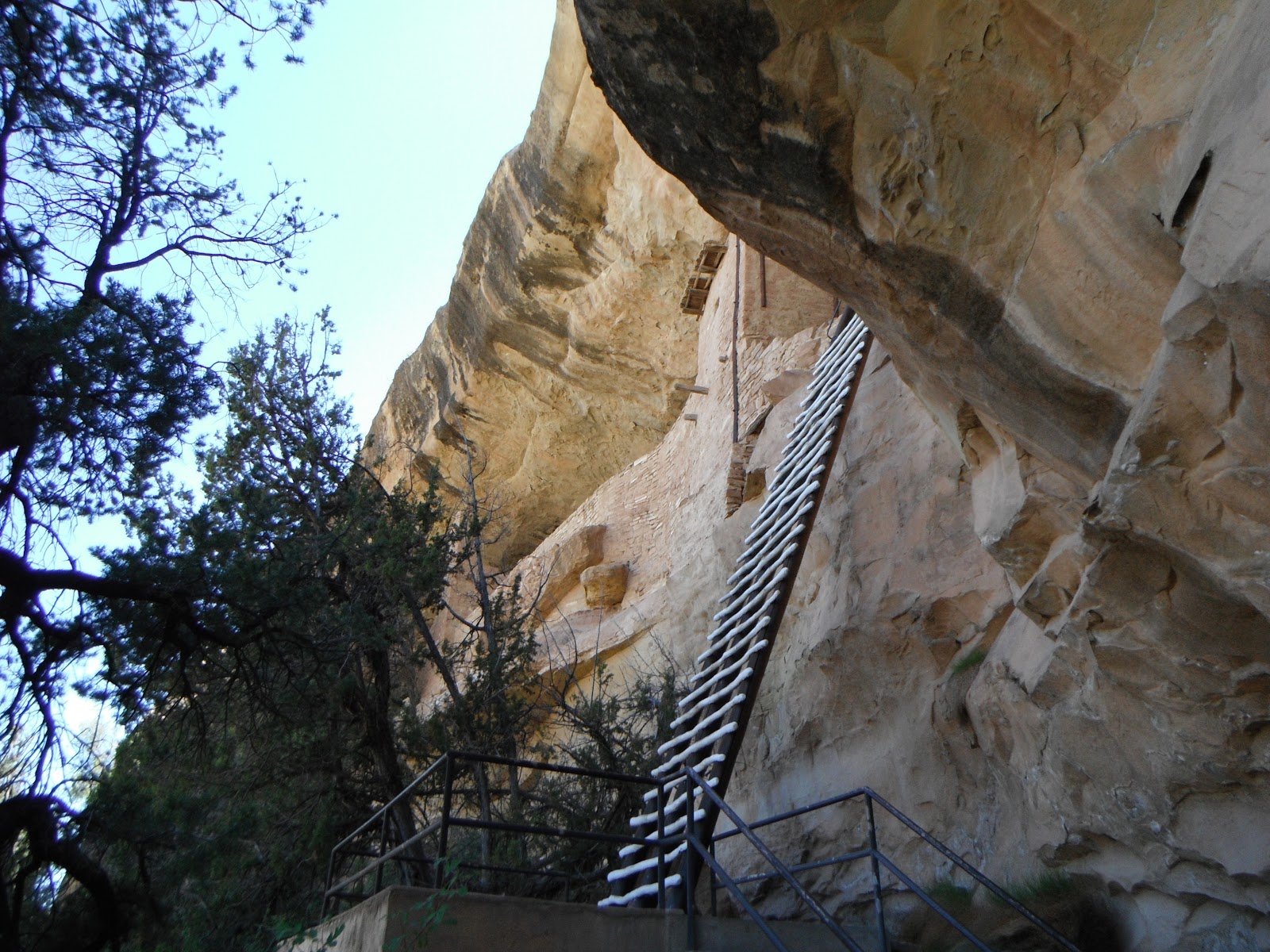
We have wanted to see Mesa Verde ever since we lived in Phoenix for two years in the late 80's.  It's the largest and most well-preserved group of cliff dwellings in the Southwest.  Though the structures endured until we finally got there, the politics have changed.  When we lived in Arizona, there was a small imbroglio over whether the Anasazi cliff dwellers (as they were then called) were the ancestors of the Navajo and Hopi, or of New Mexico's Pueblo tribes.  Apparently the issue has been resolved in favor of the Pueblo and the cliff dwellers are now referred to as the "Ancestral Pueblo."  Whew.  Glad that issue is off the table.  The structures are beautiful, haunting and are set in absolutely beautiful high desert canyons near Cortez, CO.  Kate got a kick out of going up the ladders and squeezing through small passageways.
View down into a kiva, or ceremonial space.  Beams for the roof sat on the columns.  A fire was lit on the floor in front of the small wall that looks like an altar.  It actually was a wind deflector for the draft that came in the small door.  

Dust storm in the Navajo Nation

At various times we could see the smoke from the huge forest fires in northern Arizona to the south of us.  Until we headed south, we didn't have to deal with anything but the wind, which was driving the fires there and creating dust storms where we were.  At one point as we crossed the Navajo reservation we were stopped for construction behind the only other car for miles - which also had a Hawaii license plate.

After Mesa Verde we shot diagonally south across New Mexico to Carlsbad Caverns, south of the infamous town of Roswell.  There was a lot of acrid smoke in the air until we got to Santa Fe, where it cleared and we had a beautiful lunch outside near the cathedral.  Roswell is one one of those places that causes you to scratch your head and wonder why any human would want to live there, let alone aliens.  It's a bleak, flat desert landscape.  We decided to give the UFO Museum and "Research Center" a miss, though it would have been fun to see how they treated one of the great hoaxes of all time, the "secret" video of military doctors dissecting a dead alien. 

The trail down into the cavern
South of Roswell the land gets more interesting and resolves itself into the shoreline of an ancient sea at the site of the cavern.  You can stand and look out along the shoreline - the only thing missing is the water, which drained away about 200 million years ago.   In 1898 a 16 year-old by the name of Jim White was probably the first person of European descent to enter the cavern.  Native Americans had utilized outer areas of it for millenia.  White may have been attracted to the entrance by the massive flight of bats that exits every evening.  Though he could have no idea of the cavern's size, White knew he was on to something.  Within 25 years the site was designated a National Monument.  Exploration continues today.

Looking skyward from the cavern
The cavern isn't a cave in the sense we usually think of them.  It's a series of enormous chambers, some larger than the interior of a cathedral.  The trail spirals down through a series of rooms to the enormous Big Room about 800' below the surface.  It covers an area larger than six football fields.  At one end we gaped at the entrance to yet another huge space farther below us which has yet to be fully mapped and to have trails extended there.  The cavern is a little disorienting - the mind refuses to believe the distances it's looking at.  The usual cave features of stalactites and stalagmites are found in massive size.  Dim clouds of mist gather at various places in response to changes in humidity and winds from the surface.  When we emerged from the elevator that whisks you 80 stories back to the surface, we were again disoriented by the change from the cavern-scape to the sun-bleached desert above.  We didn't have the luxury to savor the change; it was brutally hot.

When I contemplated driving our Toyota Sequoia across the country, I had piously thought we'd be very green and tool along at no more than 60 miles an hour, sipping gas and ignoring our wasteful fellow travelers.  Nah.  When you're out West, the distances are huge.  My resolve lasted about 10 minutes once we left Scott and Laurie's in LA.  At 80 mph, the miles click over in a satisfying way but the fill-ups were painful on long parts of our drive, where we would sometimes spend $150 or so on gas in one day.  We look forward to selling the beast in Maine and to not having a car for the rest of our year away.

Kate makes friends with Leo, Tim and Melissa's cat
Tim and Molly at Garden of the Gods, Colorado Springs
My cousin Tim Jamison, his wife Melissa and their three beautiful kids Molly, Luke and Kate were our hosts in Colorado Springs.  They have an incredible view from their house in the hills above town.  We mostly talked and did short activities with the kids for the two days we were there.  It was so good to see them and to catch up, as I hadn't seen them since Tim and Melissa's wedding in Yosemite about 10 years ago.  Having little kids definitely affects mobility!


 On June 12 we reluctantly took our leave and began a major push east to Boone, NC for our next reunion, this time with my nephew Joe Klein, his wife Holly and their children Zach and Greta.